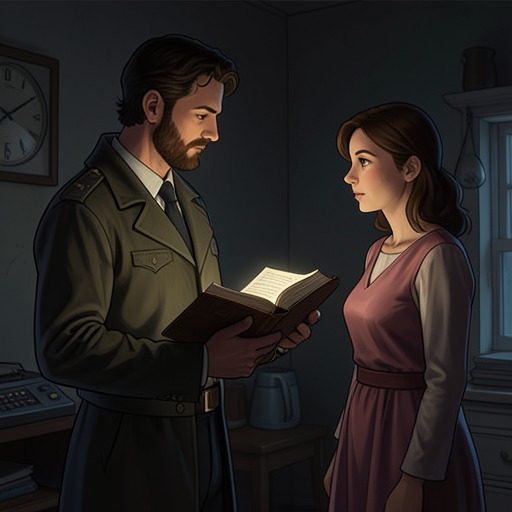
August Epp—Monica Epp
Women TalkingMonica Epp’s relationship with August Epp is defined in his account by a small childhood crisis that exposes the depth of his guilt and the tenderness, as well as the practical limits, of her response. After the family leaves Molotschna Colony for England, Monica finds August trying to mark his location for God with stones taken from their fence. She embraces him, reassures him that he is a normal child of God, and tells him the stones must be returned. The memory remains a measure of maternal comfort in a life shaped by exile, bereavement, and August’s continuing search for forgiveness.
Family Exile and August’s Childhood Guilt
August recalls that he was twelve when his parents were excommunicated and the family moved from Molotschna Colony to England. He spent years believing that the family had been forced out because he had stolen pears from a farm in neighboring Chortiza Colony. In England, where he learned to read and write, this childhood explanation became part of a broader sense that he deserved punishment: he also condemned himself for his thoughts about girls, his drawings, and his wish to be strong and to win at sports.
That guilt took a material form. In a green field, August arranged stones to spell his name so that God could find him, and tried to spell confession with stones taken from the garden fence. Monica noticed that the boundary wall between the family’s garden and the neighbors’ was disappearing. She followed the wheelbarrow rut to the field and found August using the stones to signal where he was. The scene joins his inward fear to an ordinary household consequence: the stones were at once a plea for divine punishment and pieces of a fence that needed to be put back.
Monica’s Response: Comfort and Practical Repair
Monica sat August on the ground, put her arms around him, and initially said nothing. When she spoke, she asked what he thought God intended to punish him for. August listed the pears alongside feelings and ambitions that he had interpreted as moral failings. Monica laughed, then hugged him again and apologized for laughing. She told him he was a normal boy and a child of a loving God, despite what anyone else might say.
Her reassurance did not dismiss the immediate problem. Monica explained that the neighbors were concerned about the missing fence and that August would have to return the stones. When he asked whether he could replace them after God had found and punished him, her answer held care and ordinary responsibility together: she sought to calm his fear, while still requiring him to repair what he had taken. The episode does not show her endorsing his belief that he deserved punishment. Instead, it records a mother meeting that belief with affection and a grounded task.
A Memory Reinterpreted in Adulthood
Years later, while living in England and in severe distress, August recounted the childhood episode to an older librarian. Monica’s response became the point against which the librarian framed a different understanding. The librarian said she would have told the boy that he was innocent, but also that his need to be forgiven was unusually deep, even though he had done nothing wrong. She imagined offering him a sense of being forgiven simply for being alive and in the world.
The contrast does not erase Monica’s kindness. Her words belong to the immediate scene: a frightened child, the stones, the fence, and the reassurance that he was loved by God. The librarian’s account comes later, after August has described his own persistent anguish. Through that juxtaposition, the narrative preserves both the mother’s protective response and the adult son’s unresolved question about why ordinary childhood acts had seemed to require such severe atonement. Monica remains present in his memory as a source of embrace and reassurance, even though her answer had not ended his struggle with guilt.
Separation, Bereavement, and the Family’s Legacy
August’s connection to Monica also appears through the lasting consequences of their family’s separation from Molotschna Colony. His parents’ excommunication had involved the storage and circulation of intellectual materials, including art books and photographs of paintings that his father had found and shared. When August eventually considered returning, he understood that he would have to ask Bishop Peters to accept him and to forgive his parents’ actions. His return was therefore not simply a journey back to a place associated with childhood; it carried the burden of family history and inherited shame.
Monica died while August was imprisoned in England, and his father had disappeared years earlier. By the time August describes his crisis to the librarian, he understands himself to have no family there and no one to turn to. The account does not suggest that Monica could have prevented the later losses or that her childhood reassurance resolved them. Instead, her absence sharpens the significance of the memory: the mother who once sat beside him and held him is no longer available when he confronts despair as an adult.
Significance in August’s Return and Record
Monica’s influence also persists in the details August associates with his childhood. When Ona Friesen gives him brown packaging paper on which to record the women’s meeting and list the options before them, he recalls that Monica used to give him cheese-packaging paper for drawing. The remembered material links his childhood creativity and his mother’s practical generosity to his later work as a recorder. The paper also matters because the women cannot read the minutes themselves; it is meant to remain as an artifact for others to discover.
August’s account of Monica thus connects intimate memory with the larger problem of who can preserve and interpret a community’s experience. She had comforted a boy whose imagined audience was God; as an adult, August writes down the words of women whose own literacy has been restricted. Near the end, he gathers his notebooks and the minutes and asks Salome to give them to Ona, although he knows Ona cannot read them. The gesture gives the record a life beyond its immediate readers, much as his recollection gives Monica a continuing place in the story: not as a solution to every later suffering, but as the person whose embrace and words remain part of August’s account of where he came from.